
Heat Inactivation

Heat Inactivation of Bovine Serum
Next time, let us do it for you.
Order serum with heat inactivation already completed—simply request heat inactivation when placing your order.
Order serum with heat inactivation already completed—simply request heat inactivation when placing your order.
Purpose
This protocol outlines the recommended procedure for heat inactivation of bovine serum. Heat inactivation is performed by maintaining serum at 56 ± 2°C for 30 ± 2 minutes using a controlled water bath.
Important Note:
Heat inactivation requires that the serum itself reaches 56°C and is maintained at that temperature for 30 minutes. This process typically includes an initial equilibration period (~1 hour) for the serum to reach temperature.
Placing serum directly into a 56°C water bath for 30 minutes without confirming internal temperature does not meet the definition of proper heat inactivation.
Validated, controlled procedures are essential for reproducibility. Variations in technique may result in inconsistent performance.
Heat inactivation requires that the serum itself reaches 56°C and is maintained at that temperature for 30 minutes. This process typically includes an initial equilibration period (~1 hour) for the serum to reach temperature.
Placing serum directly into a 56°C water bath for 30 minutes without confirming internal temperature does not meet the definition of proper heat inactivation.
Validated, controlled procedures are essential for reproducibility. Variations in technique may result in inconsistent performance.
Definition
Heat Inactivation (HI): A process in which serum is maintained at 56 ± 2°C for 30 ± 2 minutes.
Equipment
- Water bath capable of maintaining 56 ± 2°C (shaking water bath preferred)
- Calibrated thermometer suitable for 56°C measurement
Materials
- Product bottles of serum
- Control bottle filled to equivalent volume with thermometer inserted
- Circular lead weights
Specifications
The control bottle temperature must be maintained at 56 ± 2°C for 30 ± 2 minutes during the process.
Precautions
- For laboratory use only
- Use proper PPE and aseptic technique
Procedure
- Thaw serum completely. If thawed in a refrigerator, allow it to reach room temperature.
- Fill water bath so liquid level matches serum level in bottles.
- Set water bath to maintain serum at 56 ± 2°C.
- Prepare control bottle with thermometer (not touching sides or bottom).
- Mix serum gently until uniform.
- Place lead weights on bottles to maintain stability.
- Place bottles into water bath.
- Swirl every 10 minutes or use shaking water bath.
- Monitor control temperature closely.
- Start 30-minute timer once control reaches 56°C.
- After 30 minutes, remove bottles and cool to room temperature.
- Aliquot or return serum to freezer.
Denatured protein may appear as a gel-like or jelly-like substance, typically at the bottom of the serum bottle.
Do NOT use serum if gel or jelly-like substance is observed.
If denatured protein is observed:
Denatured protein should not be confused with fibrin.
Fibrin appears as a fine, white, flaky precipitate and does not negatively impact cell culture performance.
Do NOT use serum if gel or jelly-like substance is observed.
If denatured protein is observed:
- Do not attempt to use or salvage the serum
- Do not decant or filter for use in cell culture
- Discard the affected material according to your laboratory guidelines
Denatured protein should not be confused with fibrin.
Fibrin appears as a fine, white, flaky precipitate and does not negatively impact cell culture performance.
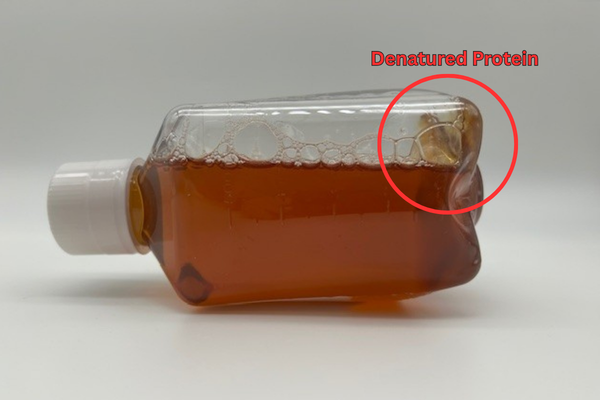
Figure: Example of denatured protein formation. Serum showing this appearance should not be used.